FINNO – a collaborative platform to support SMEs, start-ups and high-growth companies
FINNO is a collaborative platform (https://www.finnosee.eu/) set up by seven Enterprise Europe Network consortia from six neighbouring countries (Slovenia, Croatia, Bosnia and Herzegovina, Serbia, Montenegro and North Macedonia). It builds on the EEN’s expertise, services and connections, with the network’s advisors playing a central role in supporting small and medium-sized enterprises (SMEs), start-ups and high-growth companies. They support them with programmes to improve readiness to attract investment, business webinars, mentoring, innovation and internationalisation consultancy, matchmaking and access to cross-border partnerships.
As SMEs are under increasing pressure to modernise, digitalise and adapt to the green transition, the new EEN-UNIDO Action Plan 2026-2028 aims to make this cooperation even more practical. Through the training of consultants, SME diagnostics, transformation plans, pilot activities and cross-border cooperation, the EEN, FINNO and UNIDO can help companies gain the knowledge, funding opportunities and partnerships they need to become more competitive, resilient and internationally connected.
Why FINNO collaboration is important
Cooperation within FINNO is important because it builds on the solid foundations of the Enterprise Europe Network, which has been supporting SMEs since 2008. Over almost two decades, the Enterprise Europe Network has created more than just a business support network – it has developed a community of trusted organisations, experienced consultants and innovation experts working together across Europe and beyond.
This long-term collaboration has strengthened enabling ecosystems for innovation, improved the capacity of business support organisations and enabled advisors to share expertise, best practices and knowledge of markets.
FINNO builds on this cooperation by bringing together seven Enterprise Europe Network consortia from Slovenia, Croatia, Bosnia and Herzegovina, Serbia, Montenegro and North Macedonia. Through coordinated joint initiatives, Enterprise Europe Network consultants provide support to SMEs, start-ups and high-growth companies in internationalization, innovation, digital and green transitions, readiness to attract investment and access to finance.
Partners do not work in isolation, but pool expertise, networks and resources. Companies thus benefit from a wider support ecosystem, stronger cross-border partnerships and easier access to European opportunities. After all, FINNO proves that cooperation creates a greater impact than individual efforts and helps SMEs become more competitive, resilient and internationally connected.
FINNO: a platform for practical support for SMEs, start-ups and high-growth companies
FINNO was founded in 2021 as a collaboration platform of seven Enterprise Europe Network consortia from Slovenia, Croatia, Bosnia and Herzegovina, Serbia, Montenegro and North Macedonia. Its purpose is to strengthen joint work to support SMEs, start-ups and high-growth companies in preparing for financing, innovation, internationalization, digitalization and sustainable or green transition.
Since 2025, FINNO has been expanding its activities within the wider Enterprise Europe Network. Its services are divided into three main areas:
This area includes activities to connect the research sphere with the economy, companies with funding sources and companies with each other. These include the Horizons of Innovation Forum, the FINNO Pitching Academia and networking through the SMIC and EEN platforms.
Through webinars and information sessions, FINNO helps companies better understand business opportunities, willingness to attract investment, EU support instruments and doing business in participating countries.
With concrete examples of companies that have benefited from FINNO’s services, the platform shows how cooperation can lead to practical business results.
FINNO also connects with a number of partners and initiatives, including UNIDO, the EIT, the Regional Cooperation Council, the European Innovation Council, the European Bank for Reconstruction and Development, the CEFTA Secretariat, the Western Balkans Investment Framework and the WB6 Chamber Investment Forum.
Joint initiative of FINNO and EEN Thematic Group on Start-ups and Scale-ups
One concrete example of FINNO collaboration is the third FINNO Pitching Academy, organized together with the EEN Thematic Group on Start-ups and Fast Growing Companies. The program is aimed at start-ups preparing to address investors and will take place as a one-month online mentoring program from 7 to 30 September 2026.
The programme offers practical support to start-ups in verifying their willingness to invest, preparing a one-page presentation document for potential investors, improving the presentation for investors, obtaining mentoring support and presenting to investors. Participants will also receive promotion via LinkedIn and the FINNO platform.
FINNO and the EEN Thematic Group on Start-ups and Scale-ups provide a group of mentors to assist start-ups and high-growth companies in carrying out assessments, preparing materials for investors and refining presentations for investors in the pre-seed and seed phases. The FINNO Pitching Academia will also be carried out as one of the support activities of the EEN-EIT Cooperation Pilot Programme.
Helping SMEs move from ambition to execution
SMEs face several interrelated challenges in modernising, digitalising and improving their competitiveness. These include limited access to advanced technologies, insufficient digital skills, lack of strategic knowledge for the deployment of Industry 4.0 and difficulties in accessing innovation finance.
The latest data confirm why SME support is a central part of FINNO, EEN and UNIDO cooperation in Slovenia, Croatia, Bosnia and Herzegovina, Serbia, Montenegro and North Macedonia. In the EU, SMEs account for 99.8% of all businesses, almost two-thirds of employment and just over half of value added, confirming their central role in economies such as Slovenia and Croatia. In Bosnia and Herzegovina, North Macedonia, Serbia and Montenegro, SMEs also generate a large share of jobs and added value.
The UNIDO study Industry 4.0 Readiness Assessment in the Western Balkans confirms that the main constraints faced by SMEs are financial and staff-related, and not due to their attitude towards change. Budgetary constraints are the most important obstacle, cited by 71% of companies surveyed, followed by skills shortages reported by almost six out of ten companies.
This reveals an important paradox: many companies are open to Industry 4.0 and feel they can adapt to it, but less than one in ten have a clearly defined vision or a documented plan. Openness to transformation has therefore not yet translated into structured planning, so investments often remain responsive or reactive.
The capacity base is also limited. Seven out of ten companies do not have any of the specialised in-house jobs needed for the digital transition, 85% do not have a defined career path for such profiles, and eight out of ten have not carried out upskilling activities in the past year. This does not mean a lack of ambition, but a lack of structure, practical guidance and implementation capacity – the very gaps that targeted consulting, SME diagnostics, transformation planning and cross-border collaboration can help to address.
Why cooperation allows for more effective support for SMEs
Challenges and opportunities in manufacturing do not end at national borders. A cross-border approach gives companies access to a wider range of experts, technology providers and partners than a single national market can offer.
The study also highlights a structural gap in access to support to businesses: 61% of enterprises are not aware of any public support measure, and seven out of ten have not used any in the last three years. Support is often designed at a broad national level, while specialised intervention targeting directly businesses that is needed to transfer support to individual companies is still limited.
Cooperation between EEN, FINNO and UNIDO is designed to fill this gap. It brings together trusted advisors, practical methodologies, technology providers and support mechanisms, and helps companies access the knowledge and tools needed to take action.
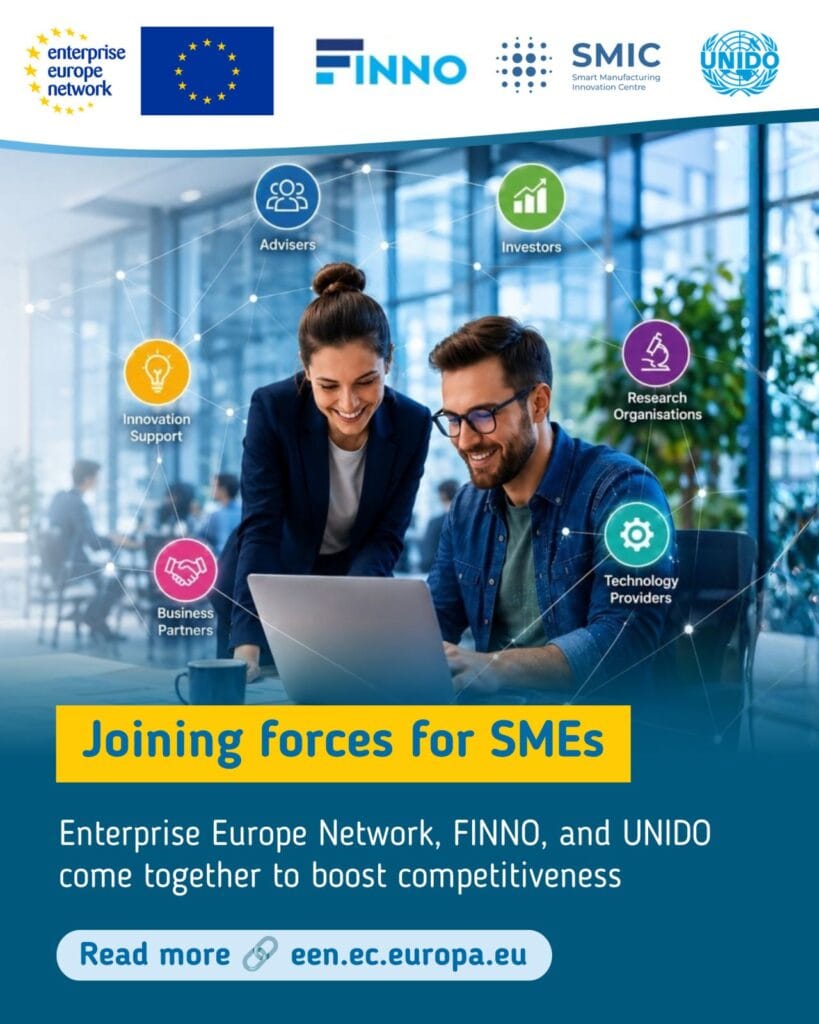
Through the Enterprise Europe Network and FINNO, companies can connect across borders with advisors, researchers, investors, technology providers and innovation support organisations. This contributes to the creation of stronger value chains, enables business partnerships and fosters the exchange of best practices in innovation, digital transformation and the green transition.
How EEN and UNIDO turn challenging topics into concrete business steps
The EEN-UNIDO Action Plan focuses on Industry 4.0, the green transition and the digital transformation, and aims to help SMEs become more productive, resilient and sustainable. In practice, this means supporting companies to deploy smart manufacturing technologies, digital tools, artificial intelligence, data analytics and related manufacturing systems.
The goal is not technology per se, but greater operational efficiency, lower costs, better decision-making and greater competitiveness in international markets.
An important part of this cooperation is the UNIDO project Promoting Industry 4.0 for the Green Transition and Circular Economy in the Western Balkans, funded by Slovenia and Cyprus. As part of the project, UNIDO carried out an assessment of readiness for Industry 4.0, developed an adapted Factory of the Future methodology, and established the Innovation Centre for Smart Manufacturing (SMIC) in Novi Sad.
On this basis, UNIDO and SMIC will train and certify a joint team of EEN consultants according to a uniform standard. This will allow companies to access diagnostics of the same quality, and the identified business needs will be able to be cross-linked with relevant technology and service providers.
The Factory of the Future methodology is not a typical assessment of the level of maturity, but begins with identifying the operational challenges and costs of the company. A certified consultant performs diagnostics at the company’s location, records its operational losses, and converts them into a concise, cost-effective transformation plan. This gives the company a practical plan – something that many companies currently do not have.
Role of Network Advisors
The network’s consultants play a key role in turning challenging topics such as Industry 4.0 and digital transformation into concrete business actions.
Through webinars, one-on-one consultations, mentoring and practical case studies, they help SMEs assess readiness, set priorities, avoid common mistakes in implementing solutions and prepare feasible digital transformation roadmaps.
Their job is not only to explain digital transformation, but also to translate the company’s overall post-modernization intent into a concrete first step. They connect companies with funding sources, training, technology providers, and other relevant support services. Instead of focusing solely on technology, they help them apply innovation where it creates measurable business value.
Experience from FINNO’s activities shows that SMEs need a holistic approach to support. Awareness raising remains important, but companies increasingly need practical technical knowledge, tailored advisory services, transformation planning, access to investors and financing opportunities, and links with business and innovation partners.
The network’s consultants play a key role in turning challenging topics such as Industry 4.0 and digital transformation into concrete business actions. Through webinars, one-on-one consultations, mentoring and practical case studies, they help SMEs assess their readiness, set priorities, avoid common implementation errors and prepare feasible digital transformation plans.
Instead of focusing solely on technology, consultants support companies in applying innovation where it creates measurable business value.
FINNO’s activities show the need for practical support
FINNO’s planned and ongoing activities, such as the FINNO Pitching Academia, the “FINNO Guides You” webinars and the collaboration with the EEN Thematic Group on Start-ups and Scale-ups, show that SMEs and start-ups are looking for practical support, not just theoretical training.
They need help preparing investor-friendly business presentations, improving presentation skills, gaining personal mentoring, understanding digital transformation, and connecting with investors and international partners. The strong emphasis on coaching, one-on-one feedback and practical tools reflects the growing demand for tailored business development support.
A concrete example is the FINNO Pitching Academy, which connects start-ups and innovative SMEs. Participants are trained to prepare presentations suitable for investors, receive personal mentoring from Enterprise Europe Network advisors, practice live presentations and receive further support even after the end of the program.
This initiative shows how collaboration can bring together the expertise of several partners and help companies improve investment readiness and connect with wider international business and investor networks.
How Enterprise Europe Network and UNIDO strengthen support for SMEs in the Western Balkans
The UNIDO study Industry 4.0 Readiness Assessment in the Western Balkans confirms that the main constraints of SMEs are financial and staff-related, and not due to attitudes towards change. Budgetary constraints are the most important obstacle, cited by 71 percent of companies surveyed, and almost six in ten cited skills shortages. Behind this is an important paradox: companies are mostly open to Industry 4.0 and feel they can adapt to it, but less than one in ten have a clear vision or a documented plan. This openness has not yet translated into a plan, so investments tend to remain reactive. The capacity base is similarly limited: seven out of ten companies do not have any of the specialised internal profiles needed for the digital transition, 85% do not have a specific career path for such profiles, and eight out of ten have not carried out any upskilling activities in the past year. The workforce in all technical areas is mostly at the entry-level level. This does not mean a lack of ambition, but a lack of structure that can be addressed with the right support.
As production challenges and opportunities do not end at national borders, a cross-border approach allows companies to use a wider range of expertise, technology providers and partners than a single national market can provide. The study shows a structural gap in access to support to businesses: 61% of companies are not aware of any public support measure, and seven out of ten have not used any in the last three years. Support is often based on a broad national level, while specialised intervention aimed directly at companies is still limited. Cooperation aims to fill this gap. It is part of the UNIDO project Promoting Industry 4.0 for the Green Transition and Circular Economy in the Western Balkans, funded by Slovenia and Cyprus. As part of it, UNIDO conducted a regional study on which these findings are based, developed a customized Factory of the Future methodology, and established the Smart Manufacturing Innovation Center (SMIC) in Novi Sad. On this basis, UNIDO and SMIC will train and certify a joint team of EEN consultants according to a single standard, so that the company can access the same quality of diagnostics in any of the participating economies. In addition, the regional CRM platform connects certified consultants, companies and technology and service providers in one system. In this way, the need identified in the production plant can be cross-linked to the appropriate provider instead of remaining unfulfilled.
In practice, collaboration is expected to help companies overcome the pattern that the data most clearly shows: the gap between intention and action. Companies are open to different Industry 4.0 tools, but the use of more advanced technologies such as digital twins, augmented and virtual reality or additive manufacturing remains below ten percent. Where technology has already been introduced, the most commonly cited effect is still “no change”. Interest alone does not bring transformation. The answer is the adapted Factory of the Future methodology, developed by UNIDO precisely for the profile of companies described in the study: owner-led companies have limited capital and a lack of specialized skills. The methodology is not used as a conventional maturity assessment, but first identifies the operational challenges and costs of the company, not just its degree of digitalization. A certified consultant performs on-site diagnostics, records the company’s annual operating losses, and converts them into a concise, cost-effective transformation plan – a plan that less than one in ten companies currently has. The green transition is included in the same diagnostics and is not added separately, as currently only 15 percent of companies have a digitally supported environmental strategy.
The study is particularly clear, as companies were asked directly. Advisory services and investment grants share the top spot; each of these forms of support was cited by 62 percent of companies. This is followed by skill acquisition support at 61 percent and access to finance at 57 percent. Companies need structured advice, capacity development and funding to almost the same extent, which provides a solid basis for the advisory model at the heart of this collaboration. It is important to highlight the difference: it is not the lack of awareness of the need for change, as companies are already open to them, but the knowledge of the support available. If almost half of the companies that have not used any support indicate that they simply did not know about it, the appropriate response is not another general awareness campaign, but a trusted advisor who works directly with the company and connects it with pre-existing sources of funding and providers that have not yet reached it.
Network consultants are the ones who put this complexity into practice, avoiding a completely abstract discussion. For companies that are open to change but lack plans, knowledge and information, abstract explanations of Industry 4.0 at the production level do not have much effect under budgetary pressure. That is why UNIDO and SMIC jointly train and certify EEN consultants to use a common methodology: in this way, every collaboration, regardless of where it takes place in the region, is based on a common standard of quality assurance. In practice, the consultant works with the employees on site, connects each observation to something measurable, expresses it as data that is already understandable to the owner, and only then implements the technology in response to a specific, cost-effective problem. Since the main obstacle is the lack of knowledge of the available options, the consultant performs another essential task: he transforms the overall intention after the update into a concrete first step and, through the platform, connects the company with financing, training or a provider that the company did not know was available to him.
What success could look like by 2028
By 2028, the aim is for more SMEs to successfully deploy digital technologies, participate in international markets, attract investment and collaborate across borders. These initiatives are expected to contribute to increased innovation capacity, better integration into European value chains and greater resilience based on sustainable and digitally supported business models.
Success should also be visible beyond formal indicators. It would mean more trust and cooperation between SMEs, a greater willingness to invest in innovation, a wider use of digital solutions and more frequent business partnerships.
Ultimately, success would mean that companies increasingly see collaboration, shared expertise and international networks as a natural part of their business development and growth.