
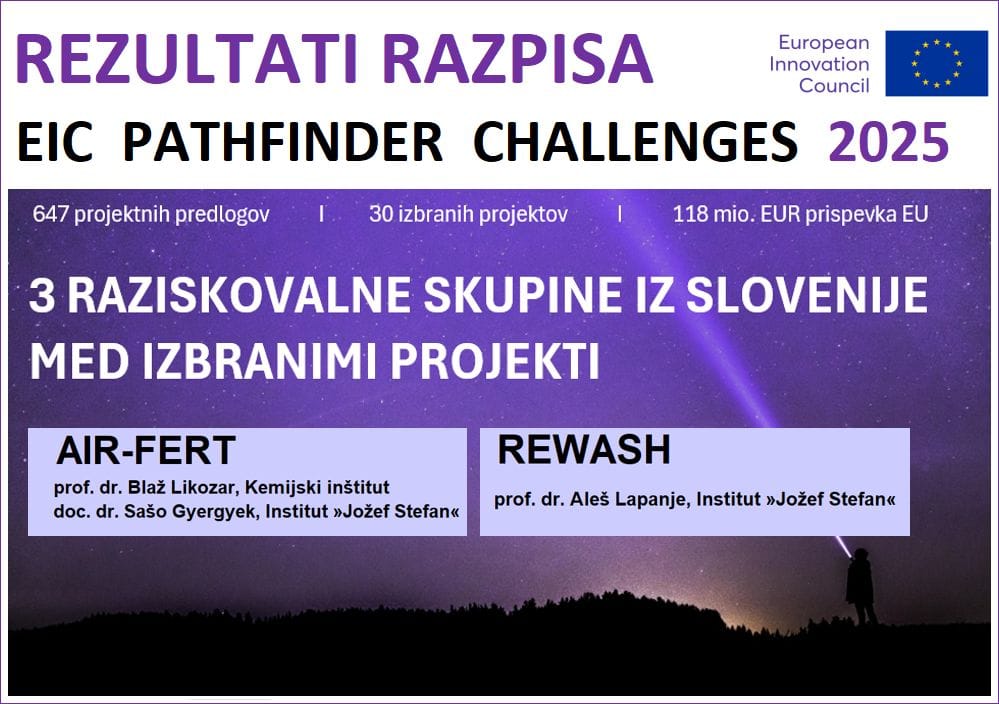
A total of 647 project proposals were submitted to the EIC call, which is aimed at developing breakthrough technologies with high risk and potential for radical societal and economic change (TRL 1-4). The thematic challenges focused on the areas of biotechnology, artificial intelligence in medicine, robotics, and the circular economy. Slovenian researchers will participate in projects within the field of the circular economy, which will develop advanced technologies for converting waste and emissions into useful resources and materials.
AIR-FERT: converting emissions into useful fertilizer precursors
The National Institute of Chemistry (NIC) and Jožef Stefan Institute (IJS) are participating in the project. The project is coordinated by Luleå University of Technology (Sweden), and the total value of the project is approximately 3.5 million euros.
The leaders of the Slovenian research efforts are Prof. Dr. Blaž Likozar (NIC) and Assoc. Prof. Dr. Sašo Gyergyek (IJS).
Within the AIR-FERT project, researchers will develop an innovative electrified modular device for capturing nitrogen and sulfur oxides from industrial and agricultural emissions and converting them into fertilizer precursors. The system will combine advanced materials and electrocatalysis to enable the direct production of fertilizer solutions, thereby contributing to the circular economy, cleaner air, and Europe’s climate goals.
The contribution of Slovenian researchers will primarily focus on the development of catalysts and multifunctional sorbents. They will develop multi-level mechanistic modeling and digitally optimize the system for better understanding and process efficiency. They will also participate in technology integration, device construction, and its validation through a pilot demonstration.
REWASH: a new approach to addressing microplastics
The Jožef Stefan Institute (IJS) is participating in the project. The project is coordinated by the research and development organization IDENER (Germany), and the total value of the project is approximately 3.4 million euros.
The leader of the Slovenian research team is Prof. Dr. Aleš Lapanje (IJS).
Within the REWASH project, researchers will develop a new approach to addressing microplastics that goes beyond mere removal and treats them as a potential resource. By using sunlight, electricity, and specially designed microbial consortia, the project enables the degradation of microplastics and their conversion into useful chemicals. This approach could pave the way for a future where polluted water becomes a source of advanced materials and medicines, while simultaneously contributing to environmental protection.
The Colloid Biology Group at IJS plays a key role in this innovation by developing a unique method for the physical organization of microbial cells, which enables their more efficient collaboration. By controlling the spatial arrangement of microorganisms, they can direct the conversion of molecules derived from plastic into high-value products.
The inclusion of projects with Slovenian research groups among the selected projects for the EIC Pathfinder Challenges 2025 call represents another significant achievement for the Slovenian research landscape, as it is one of the most competitive European instruments for funding breakthrough technologies in the early stages of development. At the same time, it confirms that Slovenian research organizations, with their expertise, contribute significantly to addressing current environmental and technological challenges and to shaping sustainable approaches and future technologies in the European Union.
We sincerely congratulate the leaders of the Slovenian portion of the selected projects and their research groups and wish them successful future research work.