
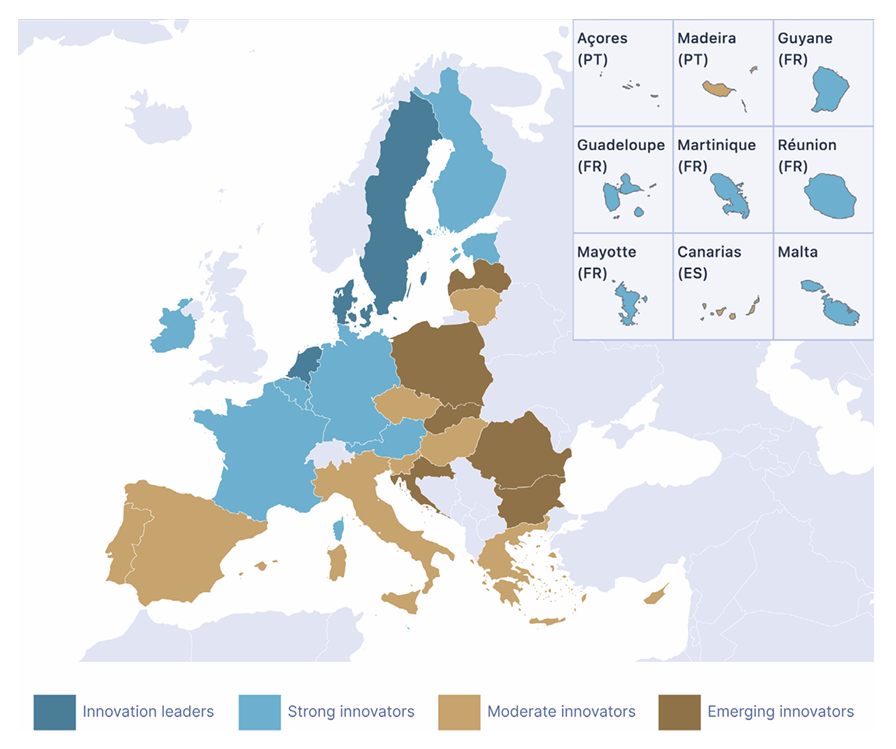
EU Member States by innovation performance groups in 2026. | Author: European Commission
The European Innovation Scoreboard (EIS) is an annual report by the European Commission that compares the research and innovation performance of EU Member States and selected other countries based on 32 indicators. The indicators are divided into the areas of framework conditions, investments, innovation activities and economic and other impacts of innovation.
In the time series calculated for this year’s edition of the index, Slovenia’s innovation performance remained broadly unchanged compared to 2025. It has improved by 7.4 percentage points since 2019, which is lower than the EU’s progress of 11.6 percentage points over the same period.
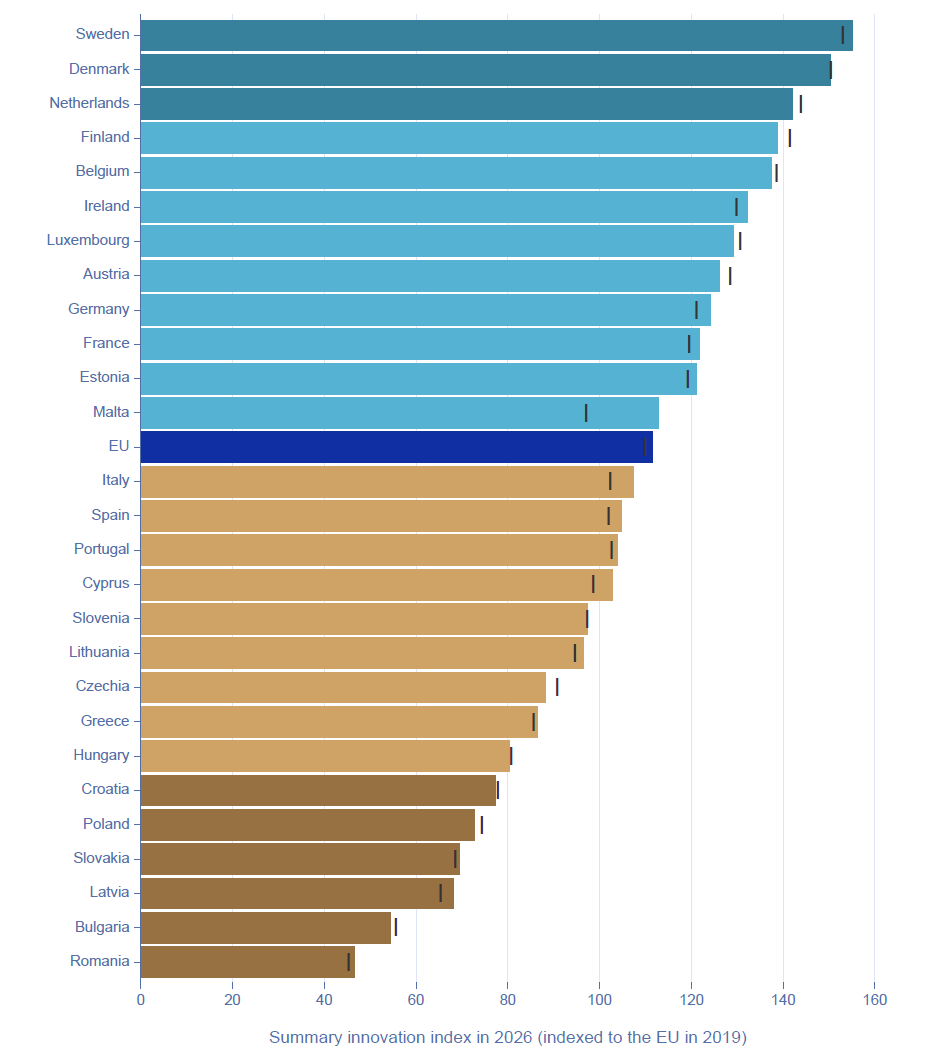
Innovation performance of EU Member States in 2026 and comparison with 2025. | Author: European Commission
Comparison with last year’s edition requires caution
Slovenia was ranked 13th in the EIS 2025 edition and achieved 94.7% of the EU average, and in this year’s edition it is ranked 17th with a score of 87.2%. These data cannot be directly compared or the differences can be interpreted only as an actual deterioration in innovation performance over one year.
The European Commission points out that the results of individual annual EIS releases may also differ for the same reference years due to data updates, shifts in the observation period, changes in the maximum and minimum values in normalisation and breaks in the data series. Trends should therefore be monitored within the time series of each index issue.
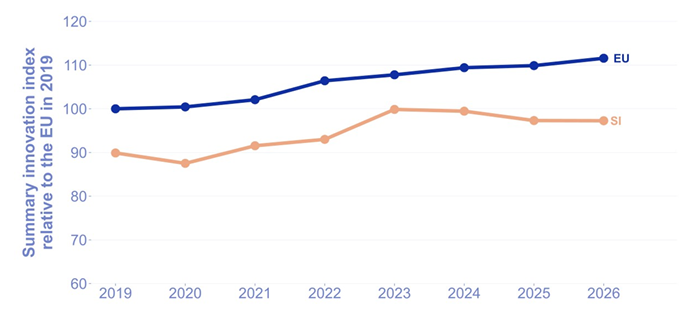
Trends in the Joint Innovation Index of Slovenia and the EU in the period 2019–2026. | Author: European Commission
Linking science and business remains an important asset
Among Slovenia’s greatest relative advantages, this year’s index highlights scientific co-publications by the public and private sectors, with Slovenia reaching 243.4% of the EU average. It also ranks high in the inclusion of the population in lifelong learning, where it reaches 168.9 percent of the EU average, and in international scientific co-publications, with 158.9 percent of the EU average.
Slovenia is also above average in the wider area of integration between stakeholders in the innovation system, where it reaches 129.9% of the EU average. In addition to cooperation between the public and private sectors, the report also highlights the growth of mobility of science and technology professionals between jobs.
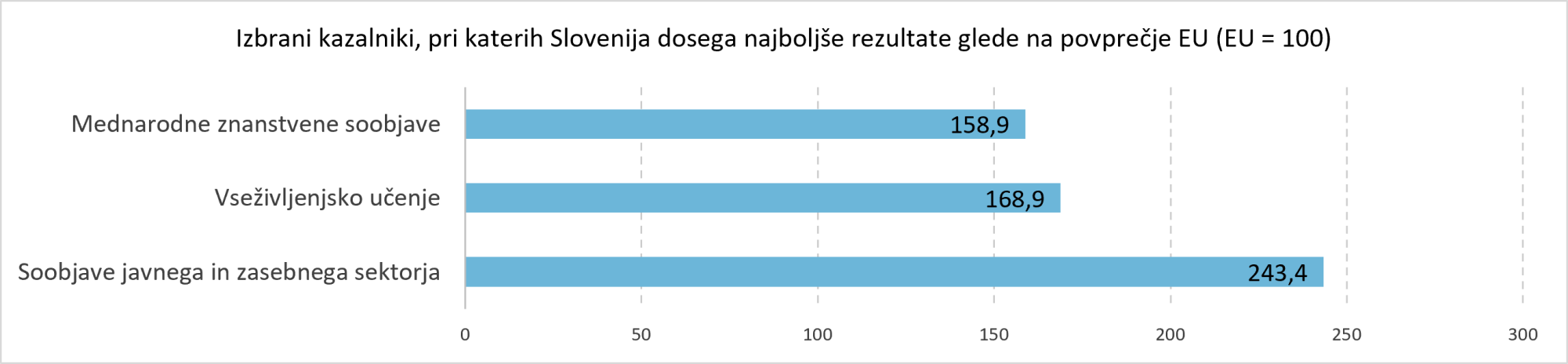
Selected indicators in which Slovenia achieves the best results compared to the EU average (EU = 100). | Author: European Commission, European Innovation Scoreboard 2026 – Country profile Slovenia
Among the indicators in which Slovenia ranks highest among the Member States are:
- exports of medium and high-tech products, where it occupies 3rd place;
- the involvement of the population in lifelong learning, where it occupies the 6th place;
- expenditure of the business sector on research and development, where it occupies 8th place.
Exports of medium- and high-tech products reach 110.8% of the EU average, which reflects the important role of more technologically demanding manufacturing activities in the Slovenian economy.
Challenges in finance, digital skills and business innovation
Slovenia remains the largest lag in venture capital expenditure, which amounts to only 21.1% of the EU average, expenditure on innovation not related to research and development (32% of the EU average), and exports of services with high added value of knowledge, which reach 41.6% of the EU average.
The field of digitization reaches 79.3 percent of the EU average, which ranks Slovenia in 23rd place. While access to high-speed internet is relatively well developed, the proportion of the population with more than basic digital skills remains a more prominent challenge. In this indicator, Slovenia achieves 57.6% of the EU average and ranks 24th.
Compared to 2025, the score also decreased in both indicators that measure the share of small and medium-sized enterprises with innovation: product innovation and business process innovation. Nevertheless, Slovenian small and medium-sized enterprises still reach 105.6 percent of the EU average in product innovation, and 66.5 percent in business process innovation.
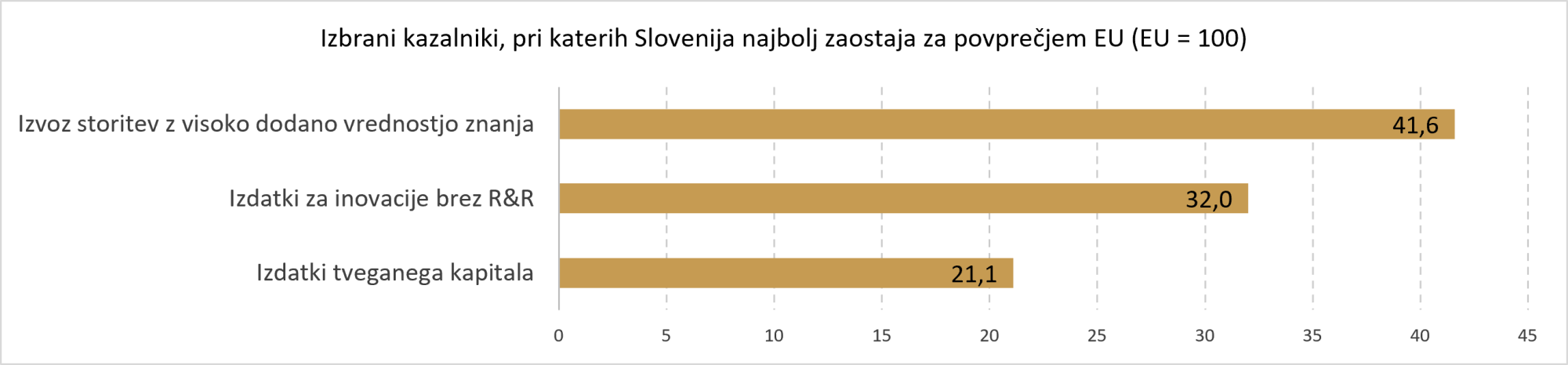
Selected indicators in which Slovenia lags behind the EU average the most (EU = 100). | Author: European Commission, European Innovation Scoreboard 2026 – Country profile Slovenia.
Basis for further innovation policy-making
The results of the European Innovation Index 2026 show that Slovenia maintains strong capacities in the production of new knowledge, strong links between the research and economic sectors, high involvement in lifelong learning, and strong exports of medium and high-tech products.
At the same time, the index highlights the need to further strengthen access to venture capital, investment in non-technological forms of innovation, digital competences, export of high value-added services and the ability of companies to introduce innovations to the market.
The findings of this year’s index will be an important basis for further monitoring of the implementation of the Resolution on the Scientific Research and Innovation Strategy of Slovenia 2030 and for planning measures to strengthen the Slovenian research and innovation system.
Source: